Showing posts with label Karma. Show all posts

Wednesday, March 27, 2019

Reviewed in Brief: The Last Firefly by Theater Mu

What does community outreach mean to you? 


Photo courtesy of Mu Performing Arts

How about accessibility?

For a lot of people I imagine the definition would be pretty literal - have you invited people to attend your show? Do you have ramps and elevators for those who can't climb stairs? That's usually where those answers end.

I'd like to open a dialogue about a deeper kind of accessibility and outreach: Who gets to make art to begin with? Where do they perform it? How do they expand their group to organically include more and more types of people?

Theater Mu (Mu), one of my favorite local companies, really excels at this mission, and their latest show The Last Firefly takes it a step further. The Last Firefly is a zippy 70-ish minute script that tells a fable about how a girl (Boom) discovers who her father (Thunder) is; finds a long-lost sister (Lightning); makes friends with woodland creatures (Monkey and Spider); and rescues her mother (Kuroko) from her evil stepfather (Ax). Its a simple, animistic tale that I find a spare beauty in and really enjoyed at the Children's Theatre Company (CTC) a couple of years ago (click here for my review). Mu's staging is decidedly less lavish than CTC's, but it includes a lot more participation from untrained actors in the local community, and the contrast was really interesting to me.

The core actors are formed of Mu cast members and are surrounded with participation from local schools. Shina Xiong makes for a plucky Boom, and what she lacks in finesse she makes up for in great energy and spirit on stage. Gregory Yang clearly relishes playing the dangerous Ax, and I loved the clean lines and physicality Kajsiab "Jade" Yang brought to her role as the zesty Lightning. I think this is Daisuke Kawachi's first time directing Mu, and he incorporates many new faces we haven't normally seen in this crew. The results have mixed success, but I think that's okay - this is a very young crew overall, with many students in their first time ever on a professional stage, and they bring so much heart and energy to their parts.

And this last point is what I really wanted to get at with the conversation about outreach and accessibility. What better way to build a theater community - both in audiences and on-stage - than to take a risk and include students in your shows? It might not give a production a highly polished sheen like you'd see on a CTC or Guthrie stage, but it will inspire a passion in the hearts of those kids and pay it forward many times over as they grow older, learn more about theater, and one day decide how they want to remain engaged with that world. I think that's an honorable cause, and one I don't see a lot of local companies take.

The Last Firefly marks a new era and a fresh start for Mu in many ways; for that reason, this is going to feel decidedly different than their other work has over the last few years. Like any new beginning there are sidesteps and stumbles; this wasn't my favorite Mu show I've seen in recent memory. But all of that said, there are so many risky, new ideas here (like that troupe of excited young actors or an abstract set design that moves around the actors - instead of the actors around the set), and I appreciate that Mu is willing to take a chance on trying something different and moving forward in an innovative new way. Watching the students on stage brought back fond memories of my first experiences in theater - scared to death, intimidated by all those blinking eyes in the darkness, and the confidence it brought when I finally found my voice there. I have always liked the sweet script of The Last Firefly and the study in contrasts between this production and CTC's gives me lots of food for thought. I think there are important places for both approaches to this story, and I'd encourage curious readers to give this show a chance to see what you think. Click here for more information and to get tickets before the show closes at Steppingstone (such a cool local venue!) on April 7.

Thursday, March 21, 2019

MUST SEE: Roe at Mixed Blood Theatre

History is way, way more important than modern society gives it credit for. 


Photo by Rich Ryan

And I'm not just saying that because I was a history major in college.

When people think of history, they tend to think of a boring giant textbook with tests that make you memorize endless dates and stories about a bunch of fusty old white dudes who have nothing to do with modern life.

History as I think of it is a living, breathing text coexisting all around us. It's the context that frames our understanding of life and culture (although we don't always know it). History doesn't just tell us the who and the when of a thing; it tells us the why. And that why really matters when it comes to solving big problems like racism or sexism or income inequality. Good history helps us understand the problem itself and the way forward by asking fundamental questions like: Why does this system exist? Who made it, and for what purpose? Can it be better? How?

Those origin questions are at the heart of Roe, a dense, fabulous new show at Mixed Blood Theatre and my first MUST SEE production of 2019. Roe tells the story of the Roe vs. Wade court decision, the infamous case that legalized abortion procedures across America. Thanks to two generations of legality, abortion is cropping up again in the cultural consciousness as an issue to be debated. Unfortunately, that debate is mostly absent the context that history provides - Why did "Jane Roe" win her case? What about her argument was compelling? What does the Supreme Court decision actually say is and is not legal? Why has this law been applied unequally state by state? What is the impact of reversing that decision and going back to the days when abortion was illegal?

Photo by Rich Ryan

These are not trivial questions, and it's imperative that we ground this conversation in context with that level of detail. Lives are literally at stake, and once this right is reversed it will not be so easy to get it back again. Roe is a MUST SEE because it provides a fully fleshed context to understand the issue of legal abortion by centering those most affected by it: women. Leading the show are Tracey Maloney as Norma McCorvey (the real life Jane Roe) and Laura Zabel as Sarah Weddington, the lawyer who argued and won the Roe vs. Wade case in front of the Supreme Court. The story could have stayed narrowly focused on the relationship between these two women and still been fascinating; the origins of the Roe vs. Wade suit and the way the case was argued are really interesting and rarely discussed. Roe's genius is that it takes that relationship, gives it the long perspective of stretching over several decades, and then adds in voices from many others along the way who seem to be otherwise completely absent from this conversation: medical professionals who worked in clinics before abortion was legal and saw the medical trauma women would go through when they were botched; experiences of any stripe of women of color; lesbians; and many more.

This subject, and the level of detail that Roe utilizes, could easily become daunting or obtuse. The brilliant cast at Mixed Blood does an excellent job of turning it into a riveting, almost game show-level piece of entertainment that educates as thoroughly as it enthralls. Maloney and Zabel are superstars in the leading roles and perfect shepherds of this material. They both bring great complexity to their performances; neither is a villain or a saint, and Maloney in particular totally disappears into her role as Norma. They force us to find empathy on all sides of the aisle, and in a debate as fraught as this one that is no mean feat. A host of spectacular supporting actors provide great depth to the show that helps transition the action through the years. Several regular favorites, such as Dame-Jasmine Hughes, Bonni Allen, and Kate Guentzel grace the stage and are just as good as ever. Two new-to-me actresses also provided astonishing depth in their short times on stage: Lisa Suarez, who was devastating as Norma's partner Connie; and Jamila Joiner, who pops out of nowhere and give a heartrending monologue at the end of the show, closing Roe out with a moving, modern understanding of what this issue really means.

Photo by Rich Ryan

Hats off to director Mark Valdez for his stunning vision for this performance. The cast is perfect and the production design sets a clean stage for the complexity of the story. Anna Robinson keeps the scenic design understated so the large cast can quickly rotate through roles, a wise choice. Sarah Bahr and Emma Gustafson provide iconic costume and wig design, respectively, placing us smack in the middle of each decade featured in the play. C. Andrew Mayer provides subtle sound design that subconsciously moves the audience between perspectives, and Paul Whitaker's lighting design fleshes out the lean set. Abbee Warmboe places several key props - such as hanging judicial coats - that loom over the drama, helping us never forget who is really in charge of this issue.

Why do I declare Roe a MUST SEE performance? For one, it's a damn good piece of theater work; the writing is tight and engaging, the cast is filled with rock star performers, and it's overall a beautifully run production. The real reason, though, is that the issue of abortion is only abstract until you need one, and people need them more often than you think. According to the Guttmacher Institute, 75% of abortion recipients are poor or low income and 62% are religiously affiliated. Perhaps most astonishingly, 59% already have at least one child and 60% are obtained by women in their 20s or older - not their teens.

Photo by Rich Ryan

It is very hard to watch the debate around abortion - especially as a woman - and know there is so much misinformation being weaponized within it. What is undeniable about this issue is that women WILL get abortions whether they are legal or not. The question as a society is: do we want to make that process safe? Do we care about the lives of pregnant women who are put at risk, or who will be put at risk by receiving dangerous care on the black market? Wherever you stand on this issue, Roe is the best thing I've seen yet that provides important context and detail to help you distill your thoughts. It turns the issue of abortion from an abstract but vitriolic debate into one with flesh and blood and very important consequences. I think any person of any belief system can find valuable information in Roe and I highly encourage everyone to check it out before it closes on April 14. For more information or to buy tickets, click on this link.

Thursday, January 17, 2019

The Children Brings a Pensive Start to 2019 in #tctheater

This disaster minded drama features impeccable acting and a thoughtful plot


Photo by Dan Norman

Art is supposed to reflect and explain the world around us, right? That said, with the political world in chaos these days it seems only natural that dystopian fiction and high drama should make appearances with increasing frequency on screen, stages and pages around the world.

The Children, the latest play on offer from Jungle Theater, falls somewhere between these two categories. Not quite dystopian (or at least as I would define it - it falls short of blatantly apocryphal scenarios like those offered in The Road, for example), it still presents a dire vision of the hard choices humanity will be required to make as the fallibility of our modern world becomes ever more apparent. Hazel and Robin are a husband and wife who have uprooted their life after the fallout of a nuclear power plant in the U.K. They are living an intense existence for the so-called first world - no power, an inability to drink running water, etc. - and are visited by surprise by an old friend named Rose. All three are nuclear scientists who helped build and run the now-failed nuclear plant in its glory days but retired before the fallout. Through the length of Rose's visit we learn of many intricate ways this group is connected that go far beyond sharing a place of work, and that Rose's visit has far deeper (and harder) implications than that of reconnecting with a long-lost friend they haven't seen in decades. The reveals are central to enjoying the show so I won't say more, but suffice it to say there are plenty of surprises scattered throughout this story.

Photo by Dan Norman

The Children can best be described as a slow burn, with a seasoned cast that gently unveils layer by layer of the lives of the trio on-stage. It couldn't work without a deep level of nuanced acting, and luckily the three actors chosen here are ringers. Linda Kelsey brings a comfortable British plebianism to her character of Hazel, with a witty charm that lightens the mood of a plot that could otherwise feel devastating. Stephen Yoakam charms as the kindly yet duplicitous Robin; when reveals are made about Robin's character, Yoakam performs them with a gentleness that knocks your heart straight below your stomach. Laila Robins is marvelous as the troubled, regretful Rose. It is Rose's mistakes and missed opportunities that drive the entire plot, and the stealthy way Robins tiptoes through the plot's many landmines keeps the suspense heightened throughout the show. You never quite know what grenade Rose will throw next, and it leads to an astonishing range of emotional experiences as a member of the audience.

Photo by Dan Norman

The set is an understated cottage interior that, like the plot itself, reveals unanticipated depth. Designed by Chelsea Warren, doors open to reveal multiple floors and windy moors; bathrooms gently flood over; working appliances transition from day to night; and overall we are firmly grounded in the eerily silent reality of Hazel and Robin's everyday life. Costumes by Mathew Lefebvre tie directly into this presentation and are comfortable and straightforward. C. Andrew Mayer performs a few neat tricks with the sound design, wisely allowing the silence and pregnant pauses between the stunning reveals of the story to do most of the work. And Marcus Dilliard grants subtle lighting to finish the environment and show the transition of the narrative from day to night.

Photo by Dan Norman

The Children is a play that defies easy description and leaves a lingering memory, much like the actions of the characters in the show. It is a pleasure to see a trio of seasoned, skillful actors share the stage on equal footing, and the fact that it was so striking to note an absence of anyone under 50 on-stage made me simultaneously thrilled to see such genius and sad that it's so rare to find in culture at large. There's a bruising, truly adult beauty to The Children's darkness that assumes a maturity of the audience that I found uncommon and often unsettling. It asks impossible questions of us: Who is worth sacrificing amidst a wide range of suffering? Is there ever a time when your own selfishness should take priority over the needs of many others? What makes a life worthy of having been lived? When humanity has taken "progress" too far to the edge, who is responsible for fixing it? How should you spend the last days of your life? The Children asks us all of this and more, and it's certain to leave a strong impression as it does so. It's a quiet, impactful start to 2019 and worthy of a viewing; click here for more information and to get your tickets.

Thursday, November 15, 2018

Children's Theatre Company's How The Grinch Stole Christmas Remains a Classic + Give to the Max Day 2019

Sometimes things are even better the second time around. 


Photo by Dan Norman

Anyone who knows me even mildly well knows that I am not a re-visitor of pretty much anything. Movies, books, plays - I am almost always a one and done. There are so many new-to-me pieces of art out there that I haven't experienced yet (and want to!) that it always feels a little silly to spend time revisiting something I am already familiar with.

Photo by Dan Norman

I made an exception this year for Children's Theatre Company's (CTC) How The Grinch Stole Christmas (click here for my original review), and I'm here to tell you: it was #worthit. No one does Dr. Seuss like CTC and this was just the thing I needed to usher myself into the holiday season and get in the mood for Give to the Max Day.

Photo by Dan Norman

I won't recap the plot because 1) I'm pretty certain everyone knows it already and 2) you can just read my original review for a full re-hash. I will say that the full charm of this production remains intact one year later, thanks to the return of the superb cast and all of the delightful tricks that make this such a charming stage show. Reed Sigmund continues to be a marvel as the Grinch, with a low leering growl and thoroughly expressive face that perfectly embody this iconic character. The best part is watching his total mastery of the children in the audience, many of whom were well under 10 years old; Sigmund is a wizard at captivating their usually short attention spans, and you could have heard a pin drop as the show progressed. He had those kids laughing, gasping and playing games at the drop of a hat. He's so good, in fact, that he makes this performance look easy. I'm here to tell you that it's not easy at all, and major kudos to his expertise (and his partner in crime Dean Holt, who narrates the show with finesse as the Grinch's dog Max) in spreading the magic of live theater to new generations of kids every single night.

Photo by Dan Norman

The delightful special effects (let's be honest - the best part of any show like this) are back this year too and they tickled me just as much the second time around. The scene where the Grinch steals the Who's Christmas trappings is worth the price of your ticket alone - between the hilarious sports sketches, lighting effects, and incredibly creative ways of stuffing presents up the chimney (that include magnets and bouncy balls), it's one of the most iconic scenes I've seen in ages and certain to delight audience members of any age. Congrats to Peter Brosius for directing this show with such vision and finesse (and to choreographer Linda Talcott Lee for providing some nail biting choreography that carries a Jim Carrey physicality to it, one of the highest compliments I can give).

Photo by Dan Norman

My favorite part about seeing How The Grinch Stole Christmas this year was taking my parents, both of whom are educators who have a deep love for Dr. Seuss and had never been to CTC. Watching their pure delight in the excellence of this production and joy at the full engagement of the auditorium filled with young kids was all the holiday cheer I needed to raise my spirits. Dr. Seuss's stories resonate because they (and especially the morals they share) are truly timeless, and How The Grinch Stole Christmas is perhaps the most timeless of them all. With all of the chaos surrounding us these days it's always appropriate to remind ourselves of the importance of gratitude, joy and treating others with kindness and respect. And grown-ups: let this story be a lesson to you of the soul sucking powers of extreme negativity. Things are stressful for all of us right now, but don't be *that guy* ruining everyone else's seasonal cheer just because you're having a bad day. Grab an extra cup of eggnog, take a walk, and do a little extra act of kindness for your fellow humans to snap yourself out of it. After all, as Dr. Seuss himself says:

Maybe Christmas, he thought, doesn't come from a store.
Maybe Christmas, perhaps, means a little bit more!

For more information about How The Grinch Stole Christmas and to buy tickets (either as a fabulous gift or a well-deserved #treatyoself moment), click on this link. Make sure to use the code INFLUENCER for 20% off of your tickets if you order before December 1!  A little fine print for those: Limit of 5 tickets per purchase. Not valid on preview performances. Not valid on VIP, Price Level C, previously purchased tickets or in combination with any other offer.  All sales are final, no refunds or exchanges.  Other restrictions and fees may apply.  Discounts are not transferrable.

Photo by Dan Norman

And before you go - today is Give to the Max Day! This is such a great opportunity to maximize any charitable donations you're making this year. There are tons of worthy arts and theater organizations that can be found by clicking here. For my shameless personal plug: please consider donating to Aeon, a group helping to fight homelessness here in the Twin Cities. I'm a member of their Young Professionals board and have my very own fundraising page up - click here to help me raise funds to keep more of our neighbors in housing through the cold winter that's coming upon us. 

Photo by Dan Norman

Monday, October 29, 2018

Reliving the Past with The Laramie Project

Here's to hoping history stops repeating itself. 


Photo by Shannon TL Kearns

It's always amazing to me how imperfectly progress on social issues is made. Causes will fight for decades on an issue with little to no improvement - or maybe even sustain severe setbacks - only to jolt society light-years into the future with a single strategic win in the courts or passing of a radical piece of legislation.

The slow pace of moving towards a better world is important to remember in times like these, when so many of us feel like we are slipping further and further into the dark ages. It's not uncommon for things to get worse before they get better, and a great way to remind ourselves of that is to pay tribute to the epochal moments that catapulted us forward in the first place.

To make an imperfect parallel as an example of such a moment: if the Stonewall riots were the LGBTQIA movement's iteration of Martin Luther King Jr.'s march to Selma (thanks to Marsha Johnson - whose name we all should remember vividly), the murder of Matthew Shepard might have been its Emmett Till. The persecution of LGBTQIA people has always been a part of our history - nothing proved that like the lack of urgency surrounding treatment and research for AIDS victims - so there isn't really a visible reason that Shepard's death should have resonated so widely. Yet, often it takes the mundanity of violence to finally reveal just how awful human nature is and how strongly it must be corrected. Reports of Shepard's last hours of suffering after a brutal beating, documented after a biker found Shepard zip tied to a fence and fatally abused, shocked and horrified the nation and marked the beginning of a shift in attitudes that culminated in passing civil rights protections based on gender and sexual identity, legalizing same sex marriage, and an ongoing national feud over protections for transgender people across the whole political spectrum.

The thing that fascinates me most about this is: why Shepard? Why do we care so much about him, specifically? Why not one of the other many thousands of LGBTQIA folks who have been hounded, killed, or assaulted over decades? I'm not sure anyone can ever develop a clear answer for this. The Laramie Project, part one of The Laramie Cycle and now under performance from Uprising Theatre Company, is probably the best attempt to frame Shepard's death in a way we can understand. It's a clear-eyed look at the tragedy through a collection of journal entries, interviews, and observations made by a theatrical team shortly after Shepard's death caught national attention in 1998. It's a fascinating show that reminds me a little of Season 1 True Detective, a foray into the world of #truecrime that gives us a far more nuanced view of middle America and the issue of violence against LGBTQIA people than we often hear elsewhere in the media. There isn't really a star or even a main character; instead, by collecting a wide range of perspectives about who Matthew Shepard was and what was so different about Laramie, Wyoming (the city in which he was killed), we get a telescopic point of view that might illuminate just why we can never take current freedoms for granted.

One of the things I like about Uprising Theatre Company is they always include a fresh face on stage. This is truly an ensemble cast, and they weave through the various narratives swiftly and delicately. There are several brand new actors to #tctheater performing here - Bruce Manning, Juliette Aaslestad, and Michael Novak all do a great job. Directors Sarah Catcher and Ashley Hovell expertly blend these fresh faces with more experienced performers like Tia Tanzer, Jessica Thompson Passaro, Seth Matz and Baku Campbell. The result is a cast with a wide representation, mimicking Laramie's surprising diversity and keeping each transition between monologues fresh. I really enjoyed these performers, who approach this difficult subject with finesse and a total lack of artifice that gives it a heightened emotional impact.

This impact is facilitated by the nearly nonexistent production design, which is essentially a collection of black boxes, a screen, and a few strategically chose small props. Combined with the simple lighting design from Jake Otto; intermittent projection design from Daniel Mauleon; and basic costume pieces that are easily changed between characters right on stage, it allows us to pay attention to the developing narrative and strips away anything that might distract from the purpose of The Laramie Project: Matthew Shepard's life and legacy in changing hearts and minds.

There couldn't be a better time to pull this show off; after all, this year marks the 20th anniversary of Shepard's death (almost to the day), and it feels like we receive daily stories of rights and protections, so recently won and so hard fought for, being stripped away with ease. It's easy to take for granted that the rights claimed by previous generations are an immutable certainty, but the fact is that we are always at risk of sliding backwards. Without intentional, consistent advocacy to continue to push our boundaries further we will never achieve the fair world that Matthew Shepard (and so many others like him) truly deserved. Learning about the people of Laramie, Wyoming and Shepard's life is one of the best ways I can think of to understand where we need to go to change hearts and minds and protect our LGBTQIA family. I enjoyed viewing this important piece of work, and I can think of no better tribute to Matthew Shepard than to stop by Plymouth Congregational Church to see this show (or its followup partner, The Laramie Project: 10 Years Later - you can see both as part of the full Laramie Cycle) before it closes on November 17. For more information or to buy tickets, click here.

And don't forget: if you want to know what you can do to protect rights already hard-won, it's pretty simple to start: Make sure you vote on November 6. Learn more about where and how by clicking here

Monday, July 2, 2018

Locally-Made Boozy Musts for July 4th Celebrations

There's never been a better time to #drinklocal


Be honest, what's better than a strong cocktail on a rooftop on a gorgeous day? Nuthin'

We're in the throes of #libation season, a favorite time of year for me, and I couldn't resist sharing some of my favorite new finds ahead of the coming holiday. If you're off on Independence Day and planning a celebration (aren't we all?), there are some kickin' local breweries and distilleries you should source some of your drinks from. I've tried selections from each of these brands and can confidently say that there is something good for everyone here. Supporting local business is always a good idea - read about some other locally-made, family-friendly treats here.

The new Finnegans taproom has so many kickass new flavors!

Finnegans: Beer for a Worthy Cause
The delightful new Finnegans tap room has received oodles of local press, and for good reason. This delish local beer brand has been brewing up a storm since well before the current craft beer craze exploded. Donating 100% of profits to charities that provide food for the hungry, Finnegans is a perfect model of having your cake and eating it too (literally) - you get affordable, delicious beer that supports the local economy, and in turn your money helps provide meals for those who don't have enough to eat. What is there to lose?

Finnegans is truly mission driven in the best way possible

I *highly* recommend you check out Finnegans gorgeous new space in Downtown Minneapolis when you get a chance (and even consider becoming a member of their exclusive Brewer's Den; more details here), but if you don't have time to do so before the holiday, pick up a case or two of one of their beers (my favorites? the Irish Ale or the Cluster Truck IPA) to sample with friends at your July Fourth cookout. I can testify that the beer is awesome and it's the perfect conversation starter to help you feel good in more ways than one.

Can't stop thinking about these gorgeous liquors

Crooked Water Spirits: Perfect Cocktails

Adhering to specific liquor brands was never really my thing, but I might change my tune after sampling the wares from Crooked Water Spirits. First things first: this line of eight spirits is good - really good. In fact, it's the first ever whiskey I've liked to drink straight, and their pre-mixed Old Fashioned has become my go-to housewarming gift for friends who drink. Their gins are made with local herbs and mix beautifully into light, summery cocktails, and you can't go wrong with just about any combo you make with their products. I've been keeping a bottle of the gin in my freezer and it's a delicious, chilled nightcap for warm days.

Heather Manley = literal #girlboss

The fact that this is the first ever certified women-owned distillery in the U.S.? That's just icing on the proverbial rum-soaked cake. I've met the founder Heather Manley, and she's a straight up #girlboss who is going to totally transform the liquor industry one barrel at a time. This line is well priced for the quality and I highly recommend you check it out. You can buy Crooked Water Spirits online by clicking here, or physically find it in Minnesota (and in many other states!) on liquor store shelves at Target, Walmart, and other local purveyors. Oh, and don't forget to follow the Crooked Water Sprits Instagram account - it will give you serious #FOMO and some awesome cocktail ideas.

Ale Asylum has a huge line of beers for every palate

Ale Asylum: A Lighter, Diverse Range of Wisconsin Beers 

For a long time Ale Asylum's brand was exclusive to Wisconsonites, but no more. With their launch at Republic last fall, Ale Asylum cracked into the Twin Cities market and has charged faithfully forward ever since. I have sampled a few of these beauties and while they're not going to knock the door down a la other local brands like Dangerous Man or Surly, they are totally drinkable, really good fits for summer outings. They've got a robust listing of different varietals - so it's not all big, hoppy IPAs if that's not your thing - including a giant range of seasonal beers. Buyers take note: these are some high ABV beers and can quickly creep up on you, so if you're outside in the heat drinking them make sure you hydrate too. If you want to know how to find a case or two to keep on the boat (#YOLO), check out Ale Asylum's awesome beer finder (click here) to search by zip code and type.

Monday, May 7, 2018

A Prescient Enemy of the People

It's amazing how some themes endure. 


Photo by Dan Norman

Something about the human condition seems to render us unable to answer one simple question - why don't we ever learn? A lust for power, flawed focus on short-term gains rather than long-term consequences, the allure of quick money - these themes tend to rise up over and over again under various guises.

Photo by Dan Norman

An Enemy of the People, originally penned by Henrik Ibsen but given a strikingly modern bend in a new adaptation by Brad Birch, takes a fresh approach to tackling such questions in the Guthrie's latest play. The play is concerned with a remote Norwegian town that has recently suffered an economic downturn. As the mayor, Peter Stockmann promises economic relief in the form of a shiny new resort, which explodes with success, drawing in many tourists and creating plenty of new jobs and income for citizens who desperately need it. Everything seems fine, until Tom Stockmann, the director of the resort who is also the mayor's brother, learns that the resort's water has been poisoned due to shortcuts taken during the its construction. Tom tries everything to report the issue and preserve public health, but is met at every turn with new obstacles that block his path - from Peter burying the knowledge to the resort's board commissioning false studies to discredit Tom's science to the newspaper refusing to run stories about the poisoned water.

Photo by Dan Norman

As Tom explores every possible opportunity to present the news, he conflicts with everyone - his wife Kate and daughter Petra; his wife's brother Morten; the newspaper editor Aslaksen; even his theoretical and ideological comrades, resident writer Billing and journalist Hovstad, are unable to stand with Tom by the end. Several pointed political monologues question Tom's motivation and flip the script; it's noble for him to want to save this one resort and one town, but what about his larger culpability for crimes committed by the first world country he lives in? Is he as concerned about the death by wars propagated by his tax dollars and global environmental poisonings from his consumer consumption? The resort is a pet project, but is it worth such a sacrifice from Tom? An Enemy of the People poses many interesting and important questions in our increasingly globalized world, and it's amazing how contemporary it all felt.

Photo by Dan Norman

Like many (accurate) stereotypes of Scandinavian art, An Enemy of the People is a quiet, dark piece, with the most meaningful moments created in the pregnant pauses created as the characters claw their way to some sort of truth. The cast deftly upholds this somber tone, beginning with Billy Carter as Tom Stockmann. Carter brings energy to his performance but without heat, and his tone grows appropriately colder as the plot thickens. Sarah Agnew gracefully foils Carter as Tom's wife Kate, with an elegantly cool demeanor that instantly recalled Robin Wright's delicious Clare Underwood. Christian Bardin was striking as Tom's daughter Petra, leaving a messy performance that had the most hope and life of all the characters on stage. Ricardo Chavira is sneaky as the mayor Peter Stockmann, and makes his villain more complex than at first meets the eye. Mo Perry is steadfast as Hovstad, providing a moral compass that puts her boss Aslaksen (played with gravitas by J.C. Cutler) to shame. And Zachary Fine brings a Lannister - Game of Thrones evil vibe to his role as Morten, leaving Zarif Kabier to provide the occasional positive relief as the writer Billing.

Photo by Dan Norman

The scenic design by Merle Hensel is sleek and spare, but always interesting. The stage is constructed on a roundabout; as each scene plays, an opaque black scrim drops to segment the stage, allowing the crew to put a totally new set in place that turns into view as the scene transitions and the stage rotates. It's hard to describe but a really efficient, austere but clean effect, and I found myself consistently engaged in enjoying the spare but polished aesthetic. Costumes (by Brenda Abbandandolo) are similarly sparse but plush, with obvious quality that gleamed even near the back of the house. The lighting design by Jane Cox and music and sound design by Brochen Chord seamlessly integrate with the set in motion and keep the audience fully engaged. I really enjoyed how thoughtfully this quiet vision was composed, and the efficiency with which it led the play - the whole thing is over in barely an hour and a half, and it keeps the long pauses and silent monologues from feeling too dreary.

Photo by Dan Norman

I really was surprised by how modern An Enemy of the People felt, and how resonant some of the pointed monologues were. Regardless of your political views, I think right now that most of us are really examining the role of the government and the people, the interplay between responsibility and contemporary practical realities, and the limits of power and conscience. What is the appropriate cost for doing the right thing? Should you lose your family, your career, your life? Are people better off left in blissful ignorance or awakened to painful truths? Who gets to decide what you deserve to know? Is there anything we can do to rein in the outsized influence multinational corporations have over our everyday decisions and needs?

Photo by Dan Norman

All of these questions, and more, are raised in An Enemy of the People, and you will leave without any easy answers. This old script still has as lot to tell us, and this beautifully adapted version will have something to say to audiences of any stripe. I know that I'll be chewing on some of these ideas for some time; if you want to engage with art containing a little more gravitas than we've seen of late, this is a good choice for you. An Enemy of the People runs at the Guthrie Theater through June 3; for more information or to buy tickets, click on this link.

Friday, May 4, 2018

This Bitter Earth is Honestly Bittersweet

It begins and ends with a bang. 


Photo by Allen Weeks

A broken bottle, a crumpled body, a shattered heart.

Photo by Allen Weeks

These events are the bookends of This Bitter Earth, a terrific new play by local playwright Harrison David Rivers that is currently showing at the Penumbra Theatre. A clear, modern, emotional, piece, This Bitter Earth tells the story of interracial queer love amidst all of the turmoil of the Black Lives Matter (BLM) movement. It's a nuanced, painfully beautiful exploration of what it means to love outside the box these days, another gem in a string of lovely plays about interracial relationships gracing stages lately, and I couldn't love it more.

Photo by Allen Weeks

This Bitter Earth is hard to summarize because, as one character says in a eulogy at the end, there's *just so much.* The play jumps around between different vignettes at various points in time in the relationship between Jesse Howard and Neil Finley-Darden. Jesse is a black writer who is finishing his thesis in New York City and later becomes a writing teacher in Minnesota; Neil is a wealthy white man from New York City who becomes heavily involved in activism through BLM as his relationship with Jesse evolves. The two men have different life goals and priorities, and their relationship is never easy; but their ardent, consistent love for one another sustains them despite the fearsome obstacles to their love. Faced with everything from disapproving stares to verbal assaults to the final attack that takes Neil's life, Jesse and Neil find a way to celebrate life's most important things - beauty, love, equality, peace - and their example is a testament to us all.

Photo by Allen Weeks

There are only two actors to carry this show, and they are perfectly cast. Kevin Fanshaw plays Neil with a nuance that gives the character the full emotional breadth he deserves, and I was so impressed with his performance. It can be hard to talk about the personal experience of being a white ally in a way that respectfully does not eclipse or erase the experiences of people of color in the movement. Fanshaw's many monologues and asides on this subject beautifully capture this difficulty without cheapening his message, and I think they really nailed this issue. Jon-Michael Reese is simultaneously complex and layered as Jesse. His role equally explores diversity in racial advocacy - not all black people agree with or are involved in BLM, and they certainly don't need to be admonished on the experience of living as people of color under American racism. Reese's deft navigation of this conversation, which is subtle and hard and vital, completes a complex picture of this relationship. Above all, Fanshaw and Reese share a tenacious chemistry that is the cornerstone of all long-lived interracial relationships: if you can't have each other's backs even at home, how can you ever survive outside your private walls? Both of these actors are fairly new-to-me and I was floored by their impactful performances. There's a lot for anyone to learn here, and I thoroughly appreciate their refined acting.

Photo by Allen Weeks

The set designed by Maruti Evans is clean, modern and comfortable. It's a spot-on background for the difficult conversations taking place on stage, and is one of my favorite I've seen at the Penumbra. The costumes by Sarah Bahr are simple, believable, and changed with lightning speed as we quickly pass through different times and locations. The lighting is warm and elegant, and I loved the way lighting designer Marcus Dillard, projections designer Kathy Maxwell and sound designer Kevin Springer worked together to create instant ambiance no matter where the action is taking place. The projections were actually one of my favorite elements; often they can feel lazy to me, as a way to uncreatively replace sets, but these projections really enhance the significance of what the characters are saying (particularly a beautiful set of quotes by various black luminaries) and instantly set the location, saving time to focus on the plot itself. Overall, I think director Talvin Wilks really nailed the vision for this play; it's cohesive, modern and impactful without feeling overwrought.

Photo by Allen Weeks

I wrote more extensively of my experience in an interracial relationship in my review of Wedding Band (also at the Penumbra) last fall, and I don't want to repeat those thoughts here. There are extremely important differences and challenges faced by same-sex couples in interracial relationships, and I appreciated how fully This Bitter Earth explored them. My favorite element of this show, however, was its firm footing in modern life. The Loving vs. Virginia decision is only 50 years old this year, and the threats to interracial (and especially interracial same-sex couples) are very, very real even (or perhaps especially) in #liberal states like Minnesota. These threats have always been visible and challenging to those of us living through them, but I have to say that something even darker seems to have publicly raised its head amidst the political tumult of the last few years. If we want to create safer, more inclusive communities, it is vital that we address these threats and prejudices head on. This Bitter Earth beautifully encapsulates the hard conversations and experiences all interracial couples are having these days. It is heartbreakingly painful to watch but it is also searingly honest, and I really appreciate Harrison David Rivers' unflinching approach and willingness to invite everyone in to help them truly understand how much this problem matters.

Photo by Allen Weeks

As I've mentioned before, this has been an absolutely dynamite year so far in the #tctheater community. It's hard to feel like I'm raving about everything I see, but honestly there have been so many truly excellent shows gracing our stages! I'm happy to say that This Bitter Earth is yet another gem in this collection. The fact that it's written by a local playwright, features bright young stars, and tackles increasingly pressing social concerns with a deft hand is just icing on the cake. The Penumbra is having a dynamite season, and I encourage you to head to Kent Street to check out their work. Artistic Director Sarah Bellamy is so thoughtfully programming around hard conversations we all need to be having and experiences that are often left ignored, and I'm sure you'll find something to love in her choices. I encourage you to visit This Bitter Earth before it closes on May 20; click here for more information or to buy tickets. Please also reference their excellent study guide to the show and issues surrounding it by checking out their well-researched feature - click here.

Photo by Allen Weeks

And seriously, the Penumbra is killing it! Here are my thoughts on the shows I've seen from them so far the past couple years - all have been truly excellent.

Monday, April 23, 2018

The Lorax is a Scintillating Show for Our Times

The Children's Theatre Company's latest show is a perfect piece for Earth Day. 


Photo by Dan Norman

Literary adaptations to stage or screen are always a tricky thing. Few fans are as ardent about faithful story-lines as book readers, and navigating the process of visualizing the collective imagination of textual characters down to the minutest detail can be a daunting task.

Photo by Dan Norman

In some ways, children's literature allows for more creative freedom in this process than novels do. After all, children's books are quite visual and can provide a more literal template from page to stage, eliminating choices that are harder when an author-approved image or vision isn't available.

Photo by Dan Norman

I imagine, however, that Dr. Seuss would provide a unique challenge of its own no matter what age range it's intended for. The imagery of Dr. Seuss books is so iconic, so unique, and so unlike anything we see in the natural world, that making it feasibly come to life involves a crazy amount of work that few companies are willing to take on. Thankfully the Twin Cities' Children's Theatre Company (CTC) is bravely up to the task (and then some); they've adapted multiple Dr. Seuss works for the stage before, but their latest The Lorax, which opened last weekend, might just be their best yet.

Photo by Dan Norman

One of the lesser known (but most explicitly political) of Seuss's tales, The Lorax is a parable about what happens when the environment becomes the least of society's priorities. A man named the Onceler is looking for a great idea to make himself rich when he stumbles upon a forest of truffula trees. The unusual trees provide fuel, food, and a remarkable material that can be knitted into fabric. The Onceler instantly seizes upon the knitting concept and knits the fronds into thneeds, a useless object that nevertheless is instantly seized upon in the consumer world. The trees are guarded by an ancient creature called the Lorax, who instantly demands the Onceler stop chopping trees down to make his thneeds; he explains that the trees require enormous amounts of care and time to grow and that chopping them down makes an irreversible error that will eliminate them forever. The Onceler ignores the Lorax's warnings, consumed by the wealth generated by thneed demand. He continues to edge out the Lorax's forest, removing trees at an ever-increasing rate until they are entirely gone. Once all the truffula trees are extinguished the Onceler sees his mistake, but it's too late: the Lorax leaves the annihilated landscape that used to be his truffula forest, and the Onceler is left to live in the wasteland of his greed. Only with the hope brought much later by a small child hearing the story for the first time can he begin to imagine a brighter future.

Photo by Dan Norman

This production has some changes from the book to flesh it out, all of which I thoroughly enjoyed. The show is shepherded by an expert, dynamic cast, all of whom seem to be having the time of their lives. Stephen Epps is the perfect choice for the greedy Onceler. H. Adam Harris is wonderful as the voice of the Lorax, and he performs some magically expressive puppet work with the help of Meghan Kreidler and Rick Miller that is truly captivating. Rajané Katurah explodes off the stage in a dynamic solo, and she's going to be one to watch in coming productions. Ryan Colbert remains one of the best new regular actors on a CTC stage, with a vividly expressive performance that had all the kids giggling. The rest of the cast is great too, rotating through multiple roles (and costumes - man those changes are quick!) at a lightning pace and with clear passion, especially Ansa Akya and Stephanie Bertumen.

Photo by Dan Norman

Speaking of the costumes, holy cow - the production value of The Lorax is perfection from top to bottom. I'd love to know how much they spent developing each piece, because the clear attention to the smallest detail is evident at all levels. The costumes and sets, designed by Rob Howell, retain an exclusive Dr. Seuss feel and a crazy amount of texture. You can almost tangibly sense the softness of each truffula tree or the slime in the thneed factory, and the costumes burst off the stage in a riot of color. The puppets, designed by Nick Barnes and Finn Caldwell, are a marvel. They have so much expressiveness, and they are moved so masterfully and expressively, that you are totally mesmerized every time they're on stage - from the flying swans to the singing fish to the Lorax himself (on first sight of whom the audience burst into applause), these are some entrancing puppets. The choreography by Drew McOnie is tightly performed and jazzy, perfectly mimicking the mood of the plot, and Emily Michaels King does some beautiful solo work as the dance leader. The lighting design (by Jon Clark) and sound design (by Tom Gibbons) is similarly timed to the smallest details, and the effects combine to make The Lorax a rich, fully visualized experience.

Photo by Dan Norman

Serious issues are making their way onto stages all over the Twin Cities, which is great to see. Race and gender and sexuality have all gotten explicit treatment in recent months, but how do you visually depict pollution as an urgent problem to be solved and a clean environment as something to be valued? I firmly believe that art is a perfect medium to help us tackle difficult subjects, and The Lorax is a genius way to address environmental issues. It may be considered a tale for children, but adults will be amazed at how quickly they are engrossed in The Lorax's beautifully told story. I know that I was pleasantly surprised at how much I genuinely engaged with this show. I couldn't stop smiling from the moment the theater lights dimmed, and if nothing else the incredible production value provides plenty of food for the eyes. I can't recommend The Lorax highly enough for people of all ages (and I truly mean that - adults are not getting cheated in this show). Hats (or thneeds, rather) off to Director Max Webster for a triumphant, creative adaptation that pulls the heartstrings, teaches a lesson, and puts a wide smile on your face all at the same time. For more information or to buy tickets before The Lorax closes on June 10, click on this link.

Monday, April 16, 2018

Turning Back Time at Guess Who's Coming to Dinner

What's in a name (or a skin tone)? 


Photo by Dan Norman

If you happened to miss it amidst our unseasonable spring blizzard (and who could blame you?), the Guthrie Theater opened their stage rendition of Guess Who's Coming to Dinner last weekend. I imagine this was scheduled specifically at this point in the season as a contrast to Danai Gurira's excellent play Familiar, which sadly closed last weekend. Both plays discuss interracial relationships and the difficulties of introducing a partner to your family who is from a different culture than you, and both are highly worth watching.

Photo by Dan Norman

But while Familiar is (at its heart) about life in an immigrant family and the unique cognitive dissonance the internal identities of immigrants hold, Guess Who's Coming to Dinner (Guess Who) is really about the external realities of existence itself. Rather than asking Who Am I?, Guess Who simply asks: Why? Why are our cultural expectations of relationships the way they are? Why are we expected to segregate ourselves? Why are our differences emphasized rather than celebrated? Why does anyone get to have a say in your relationship who isn't a part of the relationship itself? 

Photo by Dan Norman

Through a series of cringe-laugh-inducing vignettes, Guess Who (mostly) deftly navigates those questions in a way that lands a serious subject with a light blow. We see the happy couple radiate with love; we see their parents' utter dismay at their clear mutual interest; we see a satellite of other characters convincing the parents to trust their children despite all of their training to do otherwise. This is a script that is not afraid to have hard conversations in front of you, and there is a sense of voyeurism in watching the Draytons and Prentices navigate their dismay over finding themselves in a situation they could never have imagined before. 

Photo by Dan Norman

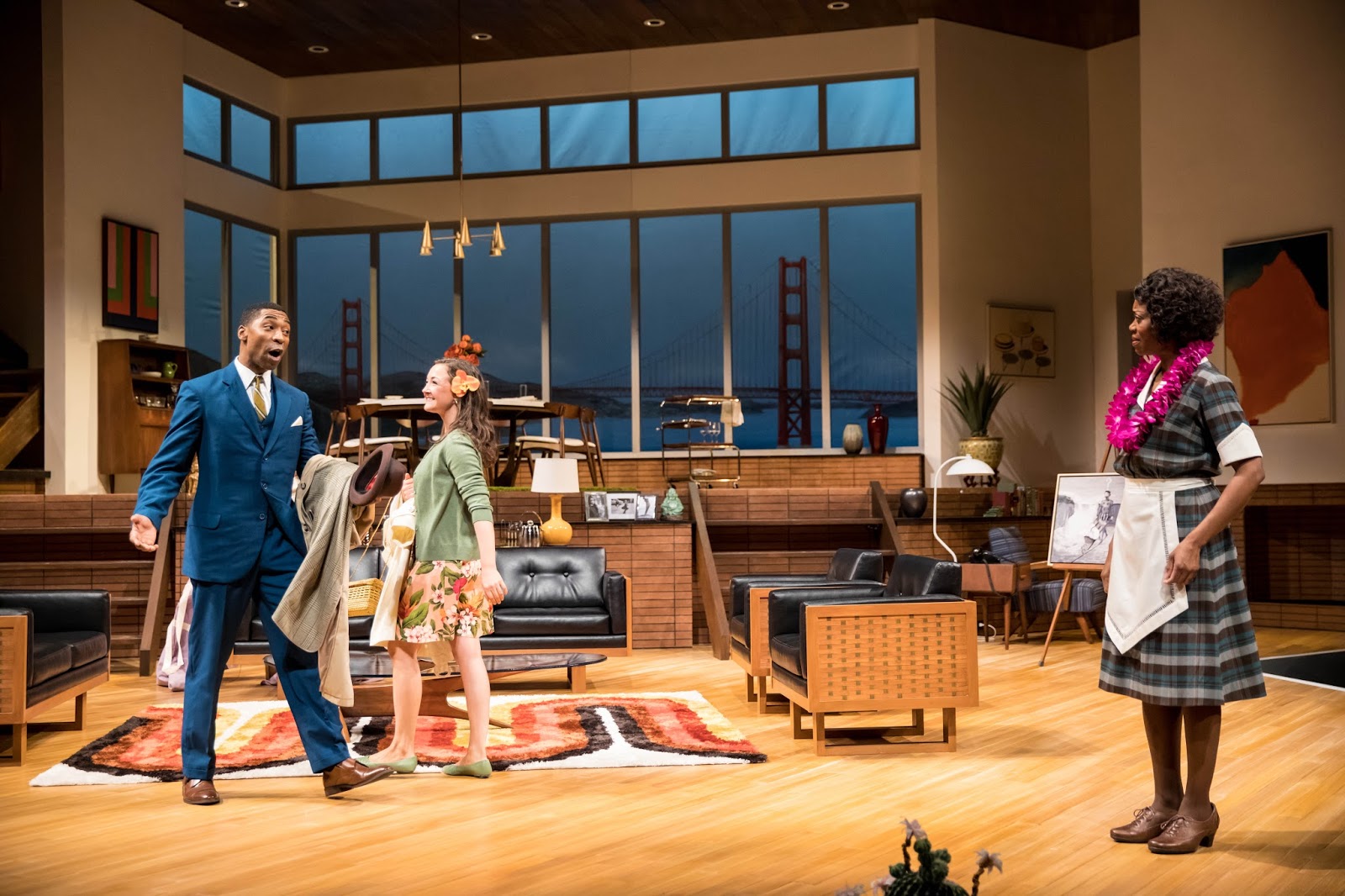
This story could easily be an uncomfortable mess without strong guidance, and Director Timothy Bond has assembled a rock star cast to help him deftly navigate the tricky material. Guthrie stalwart Sally Wingert is back as Christina Drayton. It's always tough to embody a role made famous by an actor as iconic as say, Katharine Hepburn, but Wingert makes it look easy with her expressive face and sharp wit. Speaking of inhabiting iconic roles, JaBen Early is marvelous as Dr. John Prentice. I was curious how they would put up this role that Sidney Poitier made possible; wisely, rather than trying to play Poitier, Early makes it completely his own. He has a modern, classy touch, and I thoroughly enjoyed his grounded performance. He's definitely a keeper. Regina Marie Williams is great here too as the Drayton's maid Tillie. Her role may seem insignificant, but to me, it's the crux of the entire show, and made stronger by Williams' adroit performance. Tillie is the bridge between all of these worlds; her intimate knowledge of the Draytons, her lived experience as a black woman in 1960s America, and her feet squarely planted with a black perspective living in a wealthy white world help us to the understanding that all of us can carry flawed perceptions, and all of us can overcome them. Williams does a wonderful job steering this story, and the show would be much poorer without her presence. 

Photo by Dan Norman

The rest of the cast is good too. Peter Thomson is a genuine comedic spotlight as Monsignor Ryan and often ironically voices the soundest reason of any character in the show. Greta Oglesby and Derrick Lee Weeden are profound as Dr. Prentice's parents Mary and John, respectively; their reaction, short but powerfully played here, is hard to watch but necessary. Maeve Coleen Moynihan is vivacious as Joanna Drayton, showing great chemistry with Early and a stark moral compass for the plot. And Michelle Duffy gets into her best Doloris Umbridge vibe whilst performing the sickening social climbing of Hilary St. George. 

Photo by Dan Norman

This set, designed by Matt Saunders, and the costumes, by Lydia Tanji, are just lovely. They perfectly set the time, and there is no shortage of detail to feast your eyes upon. The set remains in the exquisitely curated home of the Draytons for the duration of the show, and the instant opulence it evokes is engrossing. The costumes are classy and chic, and I wouldn't mind stealing more than a few of the looks on stage. The lighting design by Dawn Chiang adds a great level of dimension to the set, and keeps each scene feeling fresh as time passes. It's a great team effort, and meets many of the high production value productions I've seen at the Guthrie before. 

Photo by Dan Norman

I'm grateful to see this on stage as part of an increasing series of shows focusing on interracial relationships, which I have long felt receive short shrift in the cultural limelight. This kicked off with Penumbra's excellent Wedding Band, which I loved last fallFamiliar of course; and the upcoming (and locally written!) This Bitter Earth, also at the Penumbra and debuting in a couple weeks. Although interracial marriages recently hit an all-time recorded high, that level still sits at only 15% of all couples in the United States. People may be more generally comfortable with the idea of interracial relationships these days than they were in the 1960s, but that still doesn't mean they want them within their own families. It's really important to destigmatize these relationships, and I'm grateful to our local #tctheater community for working hard to talk about this issue. There are elements of Guess Who that directly correlate to my own experience of introducing partners of different races to my family (and vice versa), and although the situation in the show is dramatized, there are certainly several nuggets of truth to be found here that are quite relevant. 

Photo by Dan Norman

That being said, there are some things about this story that didn't age well, I thought, although this isn't the fault of the production itself. The conversation we see on stage is still vital, but the reception of it felt flawed. When Guess Who's Coming to Dinner first hit the silver screen in 1967, there were very few positive images of interracial relationships in popular culture, and the reception was as intense as you might imagine. Fifty years later, as with so many issues concerning race in the North (and particularly passive aggressively liberal states like Minnesota), we are able to watch a play like Guess Who and pat ourselves on the back for progress and an exceedingly judgmental eye towards the past without seeing the enormous amount of work left to do. This issue is beautifully explained in my first ever guest post back in 2016 (click here to read - it's a great summary from one of the smartest people I know), but it's something we need to talk about more. Interracial marriage is legal now, but the reception of such relationships is still problematic, and we need to do much better in general on directly closing the racial equality gap in all ways. I didn't get the sense from the laughs around me that the audience quite understood that; the point of Guess Who's Coming to Dinner is to show how deeply all of us harbor prejudice and how actively we need to root it out. It's not enough to claim liberalism or charity donations or op eds in the newspaper; we need to be actively fighting racism in our every day actions and inner thoughts, and that takes unending, exhausting work that goes far beyond writing a signature in a chequebook. 

Photo by Dan Norman

To be clear: I would absolutely recommend seeing Guess Who's Coming to Dinner. The Guthrie has mounted an excellent production with a Grade A cast, and they hit all the right notes in the staging. There's a lot to learn from the attention to detail they paid, and I think anyone can enjoy it. I would only caution you if you go to use it as a great lens to consider your own thoughts about issues about race; you might be surprised what you turn up. Guess Who's Coming to Dinner runs at the Guthrie through May 27; for more information or to buy tickets, click on this link.