There's only one more weekend to experience THE coolest interactive exhibit I've seen in a while.
100 games over 10,000 square feet? #yesplease
I'll be the first to admit that video games (and video gamers) have gotten a bad rap over the years.
You can really see the full evolution of characters
I was long an opponent of the medium. I never grew up playing video games, and it was hard for me to see the value in it.
Another popular booth: Guitar Hero
But over the years I've come to see just how rich this technology (and the worlds it builds) is. There are so many fascinating elements about video games that have started to get serious celebration from vaunted organizations (MPR's fabulous podcast Top Score about the orchestral music written for video games is one such example) and it's really bringing the world of gaming out of the small screen and into the mainstream.
The detail is extraordinary
Game Changers, an ongoing exhibit at the Science Museum of Minnesota, is the perfect vehicle for novices and hardcore game heads alike to educate themselves about this world. It's an encyclopedic exploration of the history of video games, from the very first Space Invadors and Pac-Mans to the decades-long complexities of world-building games like SimCity or World of Warcraft. Visitors can not only read about the history of these games, their technology and their creators - they can also actually play each of the games mentioned on the original equipment. And this is not to be downplayed: the arcade space is comprised of more than 100 games over 10,000 square feet, an enormous temple to the sport of true gaming.
The sketches are endless
I was really blown away by the intricacy and detail of this exhibit. There is such a lineage to the construction of games - much like novelists or painters or chefs can directly credit those who came before them as inspirations and foundations to build their art on and expand it to new heights. Many games also have original sketches and models on display so that you can see the process from ideation to inception, and it's a really powerful visual testifying to just how complex the process of creating a game is.
A group dance station was easily one of the most popular elements
The global nature of gaming is included as well, with different regions appearing in focus with distinctive art styles and plotlines. Japan is the clear standout among regions outside of the United States, but there are also creative games from Sweden, Korea and a host of other countries. It is one more example of the unifying power of sharing an interactive world with someone else, and much like Trekkies, gamers have a friend wherever they go.
Gorgeous color sketches
This is an exhibit appropriate for groups of all ages and is actually an amazing way to connect with kids whose modern knowledge of gaming you may not understand. I took my niece and nephew with me, both of whom are avid gamers, and they had the time of their lives. We don't always have a lot to talk about directly, and I learned so much about them from the way they engaged with and explained each of the games that I never would have gleaned in casual conversation. It was a really fun day and reminded me how quickly things change from generation to generation. It was almost impossible to tear the kids away from the exhibit when we needed to go and it was packed to the gills, so I can testify first hand that the price of admission is absolutely worth it. The kids even loved the current omnitheater film about Cuba, which is not a subject they're normally interested in. This trip was a grand slam in terms of keeping them interested and occupied!
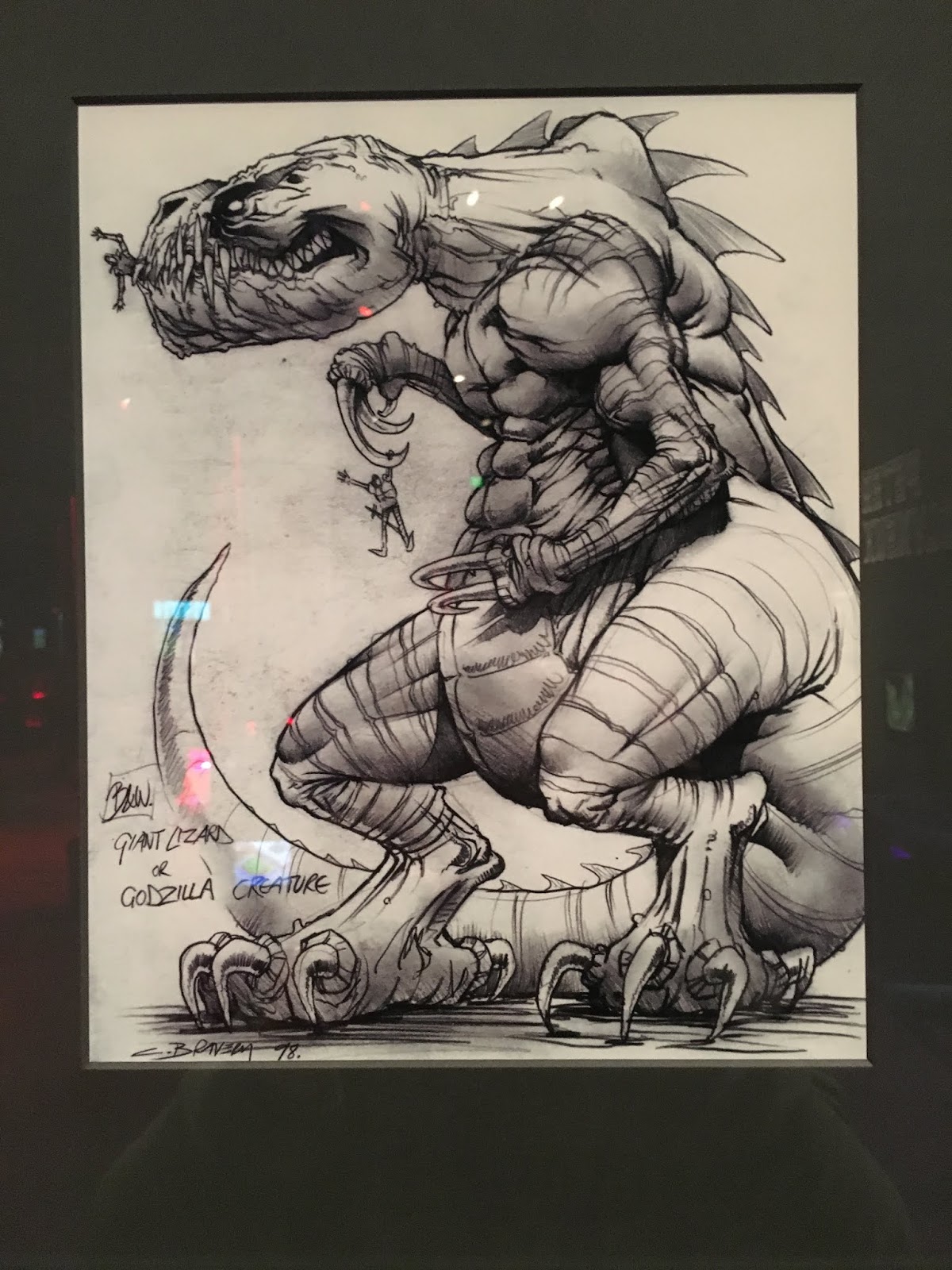
Loved this creative monster
And about that - another benefit to Game Changers is that admission is included in general admission to the Science Museum; this is not a separate ticketed event like many of their special exhibits have been. It's all the more reason to take your family or your date on a field trip to check it out before it closes on May 5. Run, do not walk, to go - there are limited edition games here that you very well may never see in working order again in your life. It's a fabulous, affordable trip for families or dates and is guaranteed to teach even the most serious gamer something they didn't know before. Click here for more information or to buy your tickets!
Up a little closer
An indicative list of the games available includes:
The Arcade Heroes section spotlights pioneering designers from the trailblazing and revolutionary arcade era, including Ed Logg (Asteroids, 1979), Tim Skelly (Reactor, 1982), Masanobu Endo (Xevious, 1982), Toru Iwatani (Pac-Man, 1980), Eugene Jarvis (Defender, 1980), Tomohiro Nishikado (Space Invaders, 1978), and Dave Theurer (Tempest, 1981).
Long lines to play the vintage games like Asteroids, pictured here
The Game Changers section features leading contemporary designers who have had a major impact on shaping the medium as we know it: Blizzard Entertainment (Diablo III 2012), Tetsuya Mizuguchi (Sega Rally Championship, 1995), Peter Molyneux OBE (Fable III, 2010), Yuji Naka and the Sonic Team (Sonic the Hedgehog, 1991), Alex Rigopulos and Eran Egozy (Rock Band 3, 2010), Tim Schafer (Broken Age, 2014), Warren Spector (Disney’s Epic Mickey, 2010), Yu Suzuki (Hang On, 1985), TT Games (LEGO Batman 3: Beyond Gotham, 2014), and Will Wright (SimCity, 1989).
Full story boards
The Indies section explores the groundbreaking and future-focused world of independent game designers. Artists such as Jonathan Blow (Braid, 2008), Capy (Critter Crunch, 2007), Eric Chahi (Heart of Darkness, 1998), Jakub Dvorský (Botanicula, 2012), Firemint (Flight Control, 2009), Halfbrick (Fruit Ninja Kinect, 2011), Introversion (Dawinia, 2005), Markus ‘Notch’ Persson (Minecraft, 2014), Rovio (Angry Birds, 2009), Erik Svedäng (Blueberry Garden, 2010), and The Behemoth (Castle Crashers, 2008) are profiled in this section.
For one of my favorite annual roundups (books, duh), look no further.
This #shelfie of goodies from my time interning at Graywolf Press is a regular fave. If you've never read any of their books, what are you waiting for?!
Devoted Compendium readers may remember my post halfway through last year on the best books I read so far (you can find it here if you missed it). There were a bunch of gems listed there, and you should still check it out - but six months later I am wiser, stronger and have plowed through a whole lot more reading material.
With a full year of perspective behind me, what were the best things I read last year? Check out my top 11 below and let me know if you agree or I missed anything big. Please note my usual disclaimer, which is: this is a top list of books I read last year, not that were published last year - so several of these are not brand new books. Still, I really enjoyed them and I think anyone can find something to love on this list. Last year's picks were equally as good - click here if you'd like to see what they were. And if you want to follow my reading adventures in real time, make sure to follow my Goodreads page by clicking here.
Best Book of Wisdom: A Testament of Hope: The Essential Writings and Speeches by Dr. Martin Luther King, Jr.
Around the time of the presidential inauguration this year I decided I didn't know enough about where we had come from in regards to civil rights, especially about how key victories of that movement were won. I decided to pick up this incredible compilation of work by Dr. Martin Luther King, Jr. and read it as a devotional throughout the year. This is one of the best literary choices I have ever made in my life. Dr. King is often viewed, quite correctly, as a hero of American history, but he is far less monolithic than is often portrayed. King was a man who held many simultaneous contradictions, who welcomed complexity and constructive conflict within his ranks, and who was able to keep a focus on love and judgement at the same time. This rich, rich compilation of all of his writings - from speeches to articles to books to letters - is a fascinating treasure trove of resistance and philosophy, and something that I wish were mandatory to teach in high schools across the country. So many of the problems facing America today are directly tied to the movement King is best known for, and I have learned more from deeply contemplating his philosophy here than I did in any religion or civics class. If you want to know the real Dr. King; learn how to create and sustain a powerful, successful political movement; define the ills and best of American history and policy; or just read the most enriching text I've ever encountered, you must read this book. It's long, it can be heavy, and it's an investment of time and money, but it's one of the best I've ever made.
Best YA / Fiction Series: Akata Witch and Akata Warrior by Nnedi Okorafor
One of my absolute favorite finds this year has been the work of Nnedi Okorafor. She strikes the perfect balance between sci-fi, fantasy, and YA work and I am obsessed with her books. Think of Akata Witch as the female-driven Nigerian version of Harry Potter. This has all the same elements: a classic, truly evil recurring villain; an unexpected magical talent; a fully hidden world of magic and spirits placed right alongside that of Lambs, or normal humans (Muggles for the Potter-initiated); a close-knit group of unlikely friends with complementary talents; a strict family; wise mentors; fantastical magical school teachings; and so much more.
We're long overdue for a more global understanding of what constitutes a true canon or mythology or great novels, and the Akata series is a wonderful entree into global fiction for readers more used to literature from Europe or the U.S. There is so much to love about Sunny, the protagonist, and the complex, delightful, macabre world she encounters. This is such a stunningly visual serial and I hope it's made into a movie; it would make a really special film series. I highly recommend this to anyone who loves magical stories, fantasy fiction, mythological tales, Harry Potter, Lord of the Rings or any of the similar books of this genre.
Best Cookbook / Self Published Local Author: Sweet Revenge by Heather Kim
A good friend recently introduced me to this gem of a book and I am still astonished that it is fully self written, self published, self designed. Everything about this book - from the lush but accessible tactile feel, to the quirky and beautiful photos and illustrations, to the perfectly named recipes and easy to follow guides and glossaries - is total perfection. I'm not a baker but even I was intrigued by recipes like the "Bite Me Scum Muffin," "Suck It Up And Grow a Pear Cheesecake" and "Lube Up Guide to Cooking Oils." For anyone with a broken heart this will be a balm to the ego and for everyone else it will be a riotously fun romp through the world of desserts. I've never met Heather Kim, but I can safely say that if this is a taste of the kind of work she outputs she's a damn smart woman and deserves every penny (and then some) she's going to make off of this self-published masterpiece. She's a locally based chef and tattoo artist, so spend a few of your Christmas dollars on buying this and supporting someone who is literally sticking it to the man and revolutionizing the cooking world one stilletto-and-spike-clad step at a time.
Best Essay Collection: We Were Eight Years In Power by Ta-Nehisi Coates
Coates's work is never easy or quick (if you haven't devoured Between the World and Me yet, get thee to a book store and clear your schedule for a day until you're done), but it's always so rich and thoughtful. I didn't fully realize that the bulk of this book was a re-print of his previously published essays for the Atlantic (most of which I had already read). Each essay is paired with a long introduction to place you exactly where he was at the time of writing and why he wrote the way he did, and to point out any structural inaccuracies. There is also a new, epic, biting epilogue to wrap the book up that chases "My President Was Black" with "The First White President."
Coates is indisputably, in my opinion, our generation's James Baldwin, and reading this was a great exercise in connecting those dots. The arc of his writing takes a meandering but pointed turn, and the last three essays of this book (particularly the razor sharp "The Case for Reparations") are ones that I have already returned to and revisited many times and I anticipate continuing to do so. Even if you're a huge fan of his work already, all of these essays are worth re-reading and anyone can find fresh vantages here, especially in our current political climate. If you do read this make sure to allow plenty of time to let it really seep in. There's so much to unpack in this book and no survey of our current place in American history is complete without it.
Best Business Book: Drop the Ball by Tiffany Dufu
Drop the Ball reflects a lot of conversations my partner and I had when we first lived together, and I wish I had had a book at the time that so clearly laid out ways in which I was not only failing myself, but failing him. We need to have higher expectations of our partners - it is insulting to treat them like mindless creatures incapable of helping around the home. We need to have higher love for ourselves - we deserve time to rest and recuperate from our busy and stressful lives. We need to get off the perfection hamster wheel - it's unrealistic and completely unnecessary, and life is way too short to get caught up in keeping up with appearances. Here's a sample of the advice Dufu covers: don't be afraid to recruit a "village" to help you. Build and maintain a network to call upon. Release your facade of perfection and meet people honestly with where you are truly at, and accept help when it is offered to you. Build strong relationships with others (especially other women). Be straightforward about your expectations and clear about your needs when you make a request. Stand up for yourself. Practice self care.
Forget Lean In; this is the book that every professional woman needs to read. Drop the Ball is a magnificent testimony to all the ways that women convince ourselves that we fall short and torment ourselves with unnecessary and unrealistic expectations. It is perfect for anyone who is too busy in their day-to-day and struggles to to find time for their real priorities (so... everyone?) and for those with a fierce imposter syndrome. What kind of world could we make if women really freed ourselves from the chains of eternal domesticity, learned to accept a little mess here and there, and instead focused our time and energy on our real passions and drive to improve society? It's an attainable fantasy, and the only people in our way is ourselves. Drop the Ball is vital for women of any age, and their partners should read it too for insight into why their S.O. has the expectations they do/is societally conditioned the way they are.
Book with the Best Ideas: Happy City by Charles Montgomery
I've recently been very interested in the politics and process of city planning and community layouts, and there was no better introduction to that subject than this beautifully written book. Charles Montgomery leaves no stone unturned in his new vision for how our urban centers could work. He truly inspired me to remember that every single thing in our lives is designed (and designed for a reason) - while this can feel defeating, it also means that it can always be changed. I really appreciated that Montgomery is not afraid to be blunt and straightforward about some of the most harmful aspects of traditional urban design, especially in the form of racism and classism. The good examples he uplifts of cities who are thoughtfully innovating for the future are truly well-rounded. For example, they always include provisions for the traditionally most reviled among us (say, drunk homeless people) in innovative, loving ways that provide spaces for all citizens - and isn't that what we say we want our societies to be in the first place?
Since I have returned to living without a car (for my day-to-day needs, at least) a few years ago, I have been so much happier and healthier. Restricting the design of our cities to be built primarily for cars is honestly tyrannical, and Happy City lays this reasoning out in compelling detail. I would urge everyone to give this wonderful book a shot and open their minds to the possibility of living differently from what conventional wisdom dictates. There are so many more ways to enjoy a rich, vivid life that have nothing to do with working thousands of hours of overtime and spending half your day commuting in a car. Definitely check this little gem of a book out!
Best Memoir / International Book: The Return by Hisham Matar
This book was one of my global book club choices (more here if you want to join too!) and it was so incredibly informational. I didn't realize how little I knew about Libyan history until I picked it up, and it's fascinating and humbling to see how ignorant I was. Matar's story of his search for his father is devastating, but through his grief he has managed to create a gorgeous testimony to the value of Libya, of the reason to fight for your freedom, and the ideal that sacrifice is worth it if the end goal benefits everyone.
If you're wondering why Qaddafi had to be removed from power and where Libya can go from here, Matar has several thoughts to share. I learned so much about North Africa and life under a dictatorship in this lyrical, lovely little book and I would highly recommend this to anyone who wants a primer on what is happening there. There are shockingly few great books about Libya and North Africa in general (tends to be the case when an entire generation's worth of writers and artists are imprisoned by a ruthless dictator... but I digress), so it behooves you to really savor the lyrical prose and rich history Matar presents here.
Best Comic Book: Ms. Marvel Volume 7: Damage Per Second by G. Willow Wilson
I've been reading the Ms. Marvel series (three cheers for a female Muslim superhero - woohoo!) for a while now but this is easily my favorite one yet. Each "issue" is a compilation of several comics, and all of the stories in this edition were so relevant, fresh and tied directly into what is happening politically right now. This is such a great way for kids to learn about issues like cyberbullying, voter fraud, gerrymandering and more (and when is the last time you heard about any of that in a comic book?!?), and I absolutely loved every inch of this top to bottom. If you need a break from your text-heavy tomes, the Ms. Marvel series is an easily digestible, quick entree into a whole new world that will really refresh your literary palate.
Best Celebrity Memoir: We're Going to Need More Wine by Gabrielle Union
I've learned about myself recently that I really like celebrity books, at least when they have something to say beyond wealth + fame = kewl. They always offer a nice break from the crazier, heavier fare I gravitate towards and can be a nice literary palate cleanser. I loved this new book from Gabrielle Union, which is much more raw and real than you usually see with celebrity memoirs. Union's no-bullshit persona has always made her one of my favorites in Hollywood and she shares so many insights here into her past, the culture of fame, the pitfalls of celebrity, and more. There are a lot of items here that can connect to a higher cultural conversation and I don't think she could have released this book at a better time, particularly in relation to the #metoo movement and omission of stories of women of color within that movement. I've heard of some issues with distribution for this book and it's such a shame, because this deserves to be read as widely as possible. This was one of my favorite recent reads - if you need a break and something relatable, saucy and thoughtful, pick this up!
Best Book for Our Times: Hunger by Roxane Gay
Roxane Gay is such an important writer that I'm not sure how to even review her bibliography - it's really in a category all its own. I adored Bad Feminist, but Hunger is so different, such a unique piece of work, that it's hard to categorize. It's far and away the best thing I've read either about obesity or sexual assault (and related PTSD), but also includes so many important details about life as a woman, as a woman of color, as a woman of size (not just heft but height), as a daughter of immigrants that I could go on and on.
There is so much incredible detail wrapped into this book, truly encapsulating an intersectional perspective and indirectly demonstrating why it is so hard to talk about intersectional issues. Which part of yourself and your identity does each of your experiences belong to? Which parts of your identity are more important? Are resources equally available to help you depending on race or gender or socioeconomic status? How do you move through pain? How does pain tangentially affect other areas of your life? How do you forgive yourself? Once you've started to heal from your pain, how do you leave it behind after you've carried it for so long?
There are so many rich, rich things to glean from this book, and I think every citizen should read it to have a more compassionate and comprehensive understanding of life as a woman who is obese, survivors of sexual assault, and an enormous range of related issues. Gay is so incredibly brave for writing and sharing this honest, raw book. I can't recommend it highly enough or thank her enough for writing it. We needed it and didn't even know it.
Best Comedy Book: You Can't Touch My Hair by Phoebe Robinson
I discovered Phoebe Robinson through the podcast 2 Dope Queens, and I'm so glad I did. Not only have I now been introduced to Phoebe's solo podcast Sooo Many White Guys (best. intro. song. ever.), but she is absolutely hilarious, so thoughtful and well rounded, and is truly helping to create an innovative new space for women and comics of color. I was really excited to read this book and it didn't disappoint, beginning with her vernacular. This casual feel allows her to really dig in to meaty issues but with humor and finesse, and she has a lot to add to many conversations (particularly around intersectionality and feminism) that are vital to our progress today. I think for women of color this book will feel familiar - none of the issues Robinson discusses will be new ones - but they still might be a hilarious new spin on old woes. As a white woman, I found a lot of what she said to be important information to me and in learning to listen to other voices and to respect/understand/honor the differences between us. For any ladies who went to the women's march and want to learn more about intersectionality and some of the specific difficulties WOC face today, this is a great primer - I'd encourage you to pick it up.
If you follow my book recommendations you know that I am obsessed with Goodreads - I have no idea how I would track all of the great reading I do over the years without it! This year I've had the good fortune to join a fabulous book club that is reading its way around the world, beginning with the Middle East. It's called Around the World in 80 Books (anyone can join! click here to find the group) and I highly recommend it - I've tremendously enjoyed the pieces we've explored so far, especially because even for an avid reader like me, it has pushed me to pick up and research things I never would have found on my own. It's free, it's easy, and it's so inspiring!
Since I seem to be crushing my target of reading 100 books this year, I thought it would be great to break up the top books with a review of the first half of the year. Wherever you're at in your reading journey, I'd highly encourage you to pick up one (or all) of these - they may seem random but they have a lot to offer! And if you want even more suggestions, follow along my blog's Books page (link here) or check out my post on the best books I read in 2016 (link here).
Most Helpful for Challenging Societal Norms: Happy City by Charles Montgomery
I've recently been very interested in the politics and process of city planning and community layouts, and there was no better introduction to that subject than this beautifully written book. Charles Montgomery leaves no stone unturned in his new vision for how our urban centers could work. He truly inspired me to remember that every single thing in our lives is designed (and designed for a reason) - while this can feel defeating, it also means that it can always be changed. I really appreciated that Montgomery is not afraid to be blunt and straightforward about some of the most harmful aspects of traditional urban design, especially in the form of racism and classism. The good examples he uplifts of cities who are thoughtfully innovating for the future are truly well-rounded. For example, they always include provisions for the traditionally most reviled among us (say, drunk homeless people) in innovative, loving ways that provide spaces for all citizens - and isn't that what we say we want our societies to be in the first place?
Since I have returned to living without a car (essentially for my day to day needs at least) a few years ago, I have been SO much happier and healthier. Restricting our cities to be built for cars is honestly tyrannical, and Happy Cities lays this reasoning out in compelling detail. I would urge everyone to give this wonderful book a shot and open their minds to the possibility of living differently from what conventional wisdom dictates. There are so many more ways to enjoy a rich, vivid life that have nothing to do with working thousands of hours of overtime and spending half your day commuting in a car. Definitely check this little gem of a book out!
Most Unexpectedly Spiritual Science Book: The Soul of An Octopus by Sy Montgomery
This is one of the most marvelous little science books I've ever read. It takes a very humanistic, Krista Tippet's On Being approach to zoology by focusing on the octopus (although plenty of other animal information is included as well) through our understanding of the octopus's consciousness. The book reads almost like a memoir, following Montgomery through her travels, her personal interactions with the octopuses (which is correct as opposed to octopi for the plural - little known fact), and other bits of knowledge about the ocean that she weaves in through the central location of the Boston Aquarium.
I've always really struggled with zoos and aquariums as "homes" for wild animals - I think it's rather cruel - but Montgomery makes quite the case for it here, describing how much safer and long lived the animals are as well as the kinds of care they receive that they never could in the wild. She also details how many octopuses (and other fish) are released, if possible, back into the wild before the end of their life so they are able to complete and breed naturally. There is no doubt that the keepers working with them are very committed to giving each a safe, happy life, and that they are imminently qualified to do so. This book lets you peer "behind the curtain" of a zoo/aquarium's operations, and it was really interesting.
Animals tend to get the short end of the stick in measuring intelligence and that is a shame. Montgomery does a wonderful job of explaining how smart octopuses are and how little we are able to comprehend their consciousness - after all, they are composed completely differently from us and have a completely different perspective on the world. There is no denying that octopuses are smart though and that they have distinctive personalities. For anyone who wonders about animal consciousness and eating meat, this will be striking.
The Soul of An Octopus is a wonderful read, especially because it closer ties us to a species not like our own. With the advance of climate change and other multi-national issues facing us, it will take all of earth's creatures respecting and caring for each other to make it through. The Soul of An Octopus really helps bridge the divide between humans and cephalopods, and it's a fascinating walk through their underwater world.
Most Societally Necessary: Hunger by Roxane Gay
Roxane Gay is such an important writer that I'm not sure how to even review her bibliography - it's really in a category all its own. I adored Bad Feminist, but Hunger is so different, such a unique piece of work, that it's hard to categorize. It's far and away the best thing I've read either about obesity or sexual assault and related PTSD, but also includes so many important details about life as a woman, as a woman of color, as a woman of size (not just heft but height), as a daughter of immigrants (I could go on and on).
There is so much incredible detail wrapped into this book, truly encapsulating an intersectional experience and indirectly demonstrating why it is so hard to talk about intersectional issues. Which part of yourself and your identity does each of your experiences belong to? Which parts of your identity are more important? Are resources equally available to help you depending on race or gender or socioeconomic status? How do you move through pain? How does pain tangentially affect other areas of your life? How do you forgive yourself? Once you've started to heal from your pain, how do you leave it behind after you've carried it for so long?
There are so many rich, rich things to glean from this book, and I think every citizen should read it to have a more compassionate and comprehensive understanding of life as a woman who is obese, survivors of sexual assault, and an enormous range of related things. Roxane is so incredibly brave for writing and sharing this honest, raw book. I can't recommend it highly enough or thank her enough for writing it. We needed it and didn't even know it.
Best History Book: White Trash: The 400-Year Untold History of Class in America by Nancy Isenberg
Talk about timely! This book could not have been published at a more opportune moment. Nancy Isenberg has written an absolutely riveting, thoughtful, highly necessary piece on the history of class in America and how it intersects with race issues. This should be required reading for every citizen. There is no way for us to solve the problems we are facing without understanding where they come from, and Isenberg starts at the very beginning. How many people know how classist the initial immigrants to America were? Or that the constitution was initially set up to base citizenship on property ownership, an influence that colors our view of people living here today? Or that the bungling of Reconstruction post-Civil War was not just devastating for former slaves but also for the white Southern poor?
The research here is exhaustive and truly spectacular, and Isenberg's pointed, clear, riveting writing is perfectly aimed to strike the heart of American mythology about progress and fairness. Although unfortunately named, White Trash is a book that will be a standard in learning about American class and race history for decades to come. If you found yourself questioning the results of the election or have a hard time understanding why white poor people tend to vote or act as they do, this is a great place to start. Also related in fictional form that is a great followup: Strange As This Weather Has Been by Ann Pancake, about the lives of coal miners in West Virginia.
Funniest: You Can't Touch My Hair: And Other Things I Still Have to Explain by Phoebe Robinson
I discovered Phoebe Robinson through the podcast 2 Dope Queens, and I'm SO glad I did. Not only have I now been introduced to Phoebe's solo podcast Sooo Many White Guys (best. intro. song. everrr.), but she is absolutely hilarious, so thoughtful and well rounded, and is single-handedly helping (at 2 Dope Queens with Jessica Williams) to create an innovative new space for comics of color. In other words: all she does is win win win no matter what.
I was really excited to read this book and it didn't disappoint. It reads just like Robinson speaks, full of her vernacular - it's like you're having a direct one-on-one conversation with her. This casual feel allows her to really dig in to meaty issues but with humor and finesse, and she has a lot to add to many conversations (particularly around intersectionality and feminism) that are vital to our progress today. I feel like for women of color (WOC) this book will feel familiar - none of the issues Robinson discusses will be new ones - but they still might be a hilarious new spin on old woes. In particular, I adore her clever way of abbreviating words. It's a little jarring at first but once you're in on the joke it's really charming and adds a lot of modernity to the feel of her work.
As a white woman, I found a lot of what she said to be important information to me and in learning to listen to other voices and to respect/understand/honor the differences between us. For any ladies who went to the women's march and want to learn more about intersectionality and some of the specific difficulties WOC face today, this is a great primer - I'd encourage you to pick it up.
Best Book for Women: Drop the Ball: Achieving More by Doing Less by Tiffany Dufu
Forget Lean In; THIS is the book that every woman needs to read. Drop the Ball is a magnificent testimony to all the ways that women convince ourselves that we fall short and torment ourselves with unnecessary and unrealistic expectations. It is perfect for anyone who is too busy in their day to day and struggles to to find time for their real priorities (so... everyone?) and for those with a fierce imposter syndrome. Drop the Ball is a perfect piece demonstrating that women need to get out of our own way in order to lead happier, healthier lives. Dufu's insights are so much more realistic and nuanced than Sheryl Sandberg's; I'd love to see more books by realistic, intersectional women like this be published.
There are a few flaws with the book that are minorly addressed but could use more treatment. The entire concept is really based on a heteronomative, committed partnership - there's not a ton of language in here for non-CIS relationships or for single people. Although these items are not often explicitly addressed, however, I still think there is a lot of wisdom that can be gleaned here that is still useful for anyone falling outside of a heteronormative partnership, and much of this advice is even more vital in that context. For example: don't be afraid to recruit a "village" to help you. Build and maintain a network to call upon. Release your facade of perfection and meet people honestly with where you are truly at, and accept help when it is offered to you. Build strong relationships with others (especially other women). Be straightforward about your expectations and clear about your needs when you make a request. Stand up for yourself. Practice self care.
I cannot rave enough about Drop the Ball. It reflects a lot of conversations my partner and I had when we first lived together, and I wish I had had a book that so clearly laid out ways in which I was not only failing myself, but failing him. We need to have higher expectations of our partners - it is insulting to treat them like mindless creatures incapable of helping around the home. We need to have higher love for ourselves - we deserve time to rest and recuperate from our busy and stressful lives. We need to get off the perfection hamster wheel - it's unrealistic and completely unnecessary, and life is way too short to get caught up in keeping up with appearances.
What kind of world could we make if women really freed ourselves from the chains of eternal domesticity, learned to accept a little mess here and there, and instead focused our time and energy on our real passions and drive to improve society? It's an attainable fantasy, and the only people in our way is ourselves. Stop preventing yourself from finding peace and success. Read Drop the Ball - it is vital for women of any age and their partners should read it too for insight into why their S.O. has the expectations they do/is societally conditioned the way they are. I adored this book, and you and your partner will too.
Best Graphic Novel(s): The March Series by John Lewis
I am so, so inspired by this wonderful series. Whoever suggested John Lewis make his story into a graphic novel is seriously a hero. I've studied the civil rights movement all my life, but something about the visual nature of this series really hit me in a way that all the thousands of textbook pages I've read never has. The art in these is truly gorgeous and I really got engaged and emotional with this story. Even in just black and white, the drawings are visceral, active and engaging, and they will keep you riveted to the narrative from start to finish. Book 3 is especially spectacular, and I promise it will keep you riveted to each page.
It's so easy to forget what happened (even in recent history) to get us to today, and the unimaginable pain the civil rights marchers went through is rendered here in astonishing, vibrant life. I highly recommend this to everyone - I think anyone can find some great, inspiring lessons here.
To the publishers: Please don't stop with this series! There is so much more of this story to be shared. I would love a graphic novel series like this on other marchers and activists, maybe Angela Davis and Cesar Chavez next?
Most Insightful: Tools of Titans: The Tactics, Routines, and Habits of Billionaires, Icons, and World-Class Performers by Tim Ferriss
I have always had somewhat of an unfair aversion to Tim Ferriss (I can't explain it, he just turns me off a little), but I couldn't resist the idea of this new book with interviews from the super successful of every stripe. I'm so glad I read this! It took a long time to get through but there is so much great information packed into these short interviews. They're funny, heartwarming, inspiring, and will kick your ass into gear towards accomplishing your goals.
In fact, this is one of the few books I would recommend re-reading and revisiting, as one pass through alone won't allow all of the great information here to really sink in. There is something in this book for everyone, from elite athletes to military personnel to comic strip authors, world renowned novelists, great chefs and titans of tech and industry. It's truly an all-encompassing book and I would highly recommend this for anyone who feels a little stuck or uninspired in their life. If you can't find anything in these hundreds of pages to cheer you, nothing ever will!
And if you're a podcast devotee like moi, check out Tim's podcasts (which each of these excerpts in the book is culled from). They're free master classes from the best in the world at their respective crafts - great for taking a long walk or run and doing some serious contemplating!
Best Memoir: The Return: Fathers, Sons, and the Land In Between by Hisham Matar
This book was one of our book club choices and it was so incredibly informational. I didn't realize how little I knew about Libyan history until I picked it up, and it's fascinating. Hisham's story of his search for his father is devastating and presumably unending, but through his grief he has managed to create a gorgeous testimony to the value of Libya, of the reason to fight for your freedom, and the ideal that sacrifice is worth it if the end goal benefits everyone.
If you're wondering why Qaddafi had to be removed from power and where Libya can go from here, Hisham has several thoughts to share. I learned so much about North Africa and life under a dictatorship in this lyrical, lovely little book and I would highly recommend this to anyone who wants a primer on what is happening there. There are shockingly few great books about Libya and North Africa in general (tends to be the case when an entire generation's worth of writers and artists are imprisoned by a ruthless dictator... but I digress), so it behooves you to really savor the lyrical prose and rich history Hisham presents here.
Best Business Book: Shoe Dog by Phil Knight
I was NOT expecting to enjoy this book as much as I did. Being somewhat of a hippie liberal, it's easy to hate on big corporations and think of them as greedy, soulless entities. That understanding, however, ignores the fact that behind every corporation is a very human, very fallible founder, who has made many tradeoffs to help realize their vision. Shoe Dog is so much bigger than being a book about Nike and touches on life, exploration, vision, determination, problem solving... I could go on and on.
Whether you love or hate Nike (particularly its sweatshop legacy), it's impossible to deny the complete revolution Nike created in the shoe industry, all of which started with a simple and noble mission to help provide better shoes made explicitly for the American body. What Nike is today is obviously far more complex than that initial vision, but there are good and bad things to all sides of that story. Be warned that this is a book solely from the perspective of the founder, Phil Knight, so it is going to be overly celebratory. Knight casts himself as the downtrodden, underestimated hero of this story, and it's a compelling narrative (although admittedly lopsided).
If you are able to set aside any concerns you might have about that, this will be a romping good read. It also really humanizes the kind of decisions corporations have to make that aren't always well publicized or explained amidst controversial media uproars. What good are corporations able to do overseas outside of eliminating their sweatshops? What kind of impact and ripple effect can a company have on something as simple as re-working the chemicals in a processing element in order to make a whole industry safer? Who preys upon the corporation itself? Shoe Dog is a really interesting exploration of these questions and so much more. Anyone interested in creating a start-up or learning more about the interior mechanisms of corporate manufacturing should pick this up. It's not only inspiring, it's enlightening, and you will absolutely fly through it.
CD's are out and vinyl is in. MP3 players went the way of the dodo, and parachute pants and chokers are back on fashion's frontlines. But you know what old technology is having the biggest renaissance of all? Radio.
Radio in the form of podcasting, that is. Who could have predicted even 10 years ago that an over 100-year-old technology would be the way of the future? With smash success podcasts like Serial and S Town (the former which broke the internet on its release in 2014 by going straight to #1 on iTunes and hitting 5 million downloads faster than any other podcast; and the latter which smoked Serial's record two years later by hitting 10 million downloads in only four days) sweeping the nation and jumps into the podcast pond from everyone from blogger influencers to Malcom Gladwell and Tim Ferriss, it seems everyone has some skin in the podcast game.
And why not? Personally, I think that in our oversaturated pop culture and era of unending newsfeeds, blips, clips, and quick taps and swipes there is a *deep* yearning among the general populous for thoroughly researched stories, nuance and thoughtfulness. It's why we're seeing such an upsurge in readership of major news and long form publications that have struggled ever since the internet ripped the print business model to shreds, or seeing an upsurge in interest in documentaries, or have long-form monologues like John Oliver's Last Week Tonight receiving millions of YouTube hits. People crave considered perspective, and it's just not possible to provide that level of insight in a 140-character soundbyte.
I am a huge fan of podcasting, online shows and long-form comedy for all of the above reasons. Additionally, they provide a free medium that can give me something to do on my walking commute or data entry days, and there are so many terrific, totally unique podcasts* that provide information I can't really find elsewhere. So I was so excited when MN Tonight reached out and asked if I would be willing to attend a live recording of Episode 5 of Season 2 of their life TV show. Although MN Tonight isn't technically a podcast (it's an online television program), the format really felt like my favorite podcast and comedy shows, so it was an opportunity to witness something totally new. I'd never heard of the show, but I couldn't pass this one up; an opportunity to indulge my nascent podcast obsession, get an inside view into how online shows are recorded and written, and learn more about serious issues facing Minnesotans today? SIGN ME UP SALLY.
MN Tonight is a multifaceted package; think Steven Colbert's musical interludes meets the Daily Show's correspondents meets John Oliver's well-researched monologues and interviews, and wrap all that up with a focus solely on Minnesota politics and current events, and you have a good idea of the subject matter. Season 1 tackled light subjects such as Islamophobia, police brutality, water quality, trans rights, and marijuana and liquor law changes on the ballot. Season 2 fits right into the fold with episodes (so far) on the bee and pollinator crisis, refugee communities, and affordable housing, all issues about which I'm super passionate and deserve a deeper (and more fun) dive than local newspaper clips are able to provide. Wednesday's show was a bit of a mix-up due to the special session at the state legislature; the show had Representative (and all-around #girlboss) Peggy Flanagan on deck to discuss the urgent issue of affordable childcare in the state, but she was unable to attend due to, you know, doing her job and shit. Thankfully the team was able to pull in Bharti Wahi, the inimitable head of the MN Children's Defense Fund**, and she did an admirable job of explaining the issues facing our state's most vulnerable population. MN Tonight founder Jonathan Gershberg did a good job of pinch-hitting to help fill the gaps, and it will be very interesting to see where he takes the show as he matures in his role as the show's host.
Outside of the featured interview, there were some inspired performances by the Shrieking Harpies***, who provided a few hilarious (and totally improvised! so impressive) songs about the Minnesota summer, brunching and other awkward tales. Kerri and Kenzi did a hilarious segment on the issue of legalizing weed that hit home with much of the Millennial audience. But my favorite sketch was easily Native American correspondent and MN Tonight writer Dave Anaya's wonderful segment on LIHEAP****, a vital federally funded program that provides financial assistance to provide heat through the winter for those with low incomes. As you might imagine this is an issue key for Minnesotans, and is urgently threatened as the program is on the chopping block in Trump's new budget. Anaya gave a richly rounded overview of LIHEAP and argument in its favor, and I would love to see more segments from him in the future. His winning delivery and clear passion for the subject really sold it to the audience, and you could see him fitting right in with Trevor Noah's Comedy Central crew.
Despite the programming hiccups, I had a romping good time at MN Tonight and I'm looking forward to tuning in to future performances. It's so fun when organizations "lift the veil" and allow audiences to participate in their activities. I stand 1,000% behind MN Tonight's mission to make issues that tend to be dry or boring for people in Minnesota a little "sexier," and I think they have a crack team that's only going to go further. I LOVE that they focus on issues facing all of Minnesota, even the small, poor, rural areas. I grew up in a small town and although I'm a city girl now, there are tons of people still living outside of the Metro and their issues matter too! There's a clear focus on diversity in the show, and I imagine that will only continue to grow as it evolves. The Brave New Workshop is a great comfy venue for MN Tonight and I hope that as the audience grows, more live shows can be added than just once a month (think Prairie Home Companion style).
I highly encourage you all to check out MN Tonight - I mean it IS free y'all - and support some of the causes they are detailing. The show is not only fun but provides real, actionable ways that all Minnesotans can be involved in making our state a better, safer, happier, healthier place to live, and who doesn't love that? Plus at the very worst, their branding is dope AF and you can get some gorgeous new local art to Instagram. Tickets are $10 in advance or $12 at the door. You can check out MN Tonight at their website here, where details about the next live show and copies of past episodes can be found.